Consensus Thermometer: Research Framework
Introduction
The Consensus Thermometer represents a research framework for measuring when collective belief systems become fragile. Rather than a unified product or system, it is a collection of independent research-grade indicators that quantify different aspects of consensus dynamics and fragility.
This framework emerges from the core insight that markets don't fail because of information — they fail because of consensus. When everyone believes the same thing, the system becomes fragile. The Consensus Thermometer provides tools for measuring this fragility.
The framework decomposes consensus fragility into measurable components: density (how concentrated beliefs are), entropy (how diverse beliefs are), divergence (how far consensus is from reality), and velocity (how fast consensus is changing). Each indicator is independently verifiable, independently refutable, and addresses different structural questions about belief system vulnerability.
Cognitive Mechanisms
Consensus fragility emerges from well-documented cognitive and behavioral mechanisms:
Information Cascades: When individuals observe others' actions and infer information, cascades can form where everyone follows the crowd regardless of private information. This creates concentrated, fragile consensus.
Herding Behavior: Social proof and mimetic behavior lead participants to copy others, creating belief concentration even without fundamental justification.
Confirmation Bias: Once consensus forms, participants seek confirming evidence and dismiss contradictory signals, reinforcing fragility.
Availability Heuristic: Recent, vivid information dominates belief formation, creating rapid consensus shifts when salient events occur.
Groupthink: In cohesive groups, desire for harmony overrides critical evaluation, creating low-entropy, high-density consensus states.
These mechanisms interact to create belief systems that can be simultaneously strong (widely held) and fragile (vulnerable to collapse). The Consensus Thermometer framework measures the structural properties that emerge from these cognitive dynamics.
Measurement Approaches
The framework employs four independent indicators, each measuring a distinct aspect of consensus fragility:
Primary Indicators (core structural measures): 1. Consensus Density Index (CDI): Measures belief concentration 2. Belief System Entropy (BSE): Measures belief diversity 3. Divergence Magnitude Score (DMS): Measures consensus-reality gap
Secondary Indicators (conditioning variables): 4. Consensus Velocity (CV): Measures speed of belief change
These indicators are intentionally independent. Each can be validated or refuted separately. Failure of one indicator does not invalidate others. This decomposition makes the research "anti-fragile" — robust to individual component failures.
The indicators are research-grade metrics, not product features. They represent academic contributions to consensus dynamics literature and invite institutional collaboration for refinement and validation.
Consensus Concepts Visualized
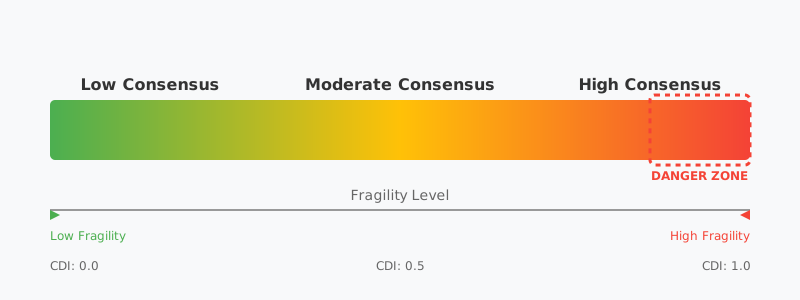
Consensus Spectrum
The consensus spectrum shows how belief concentration (CDI) relates to fragility. High consensus creates dangerous fragility zones.
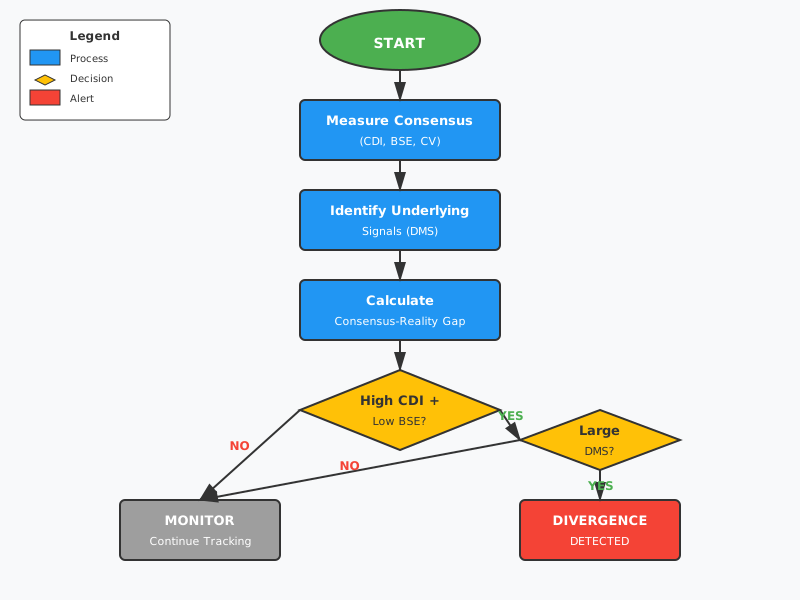
Divergence Detection Process
A flowchart showing how the framework detects consensus-reality divergence by combining CDI, BSE, and DMS indicators.
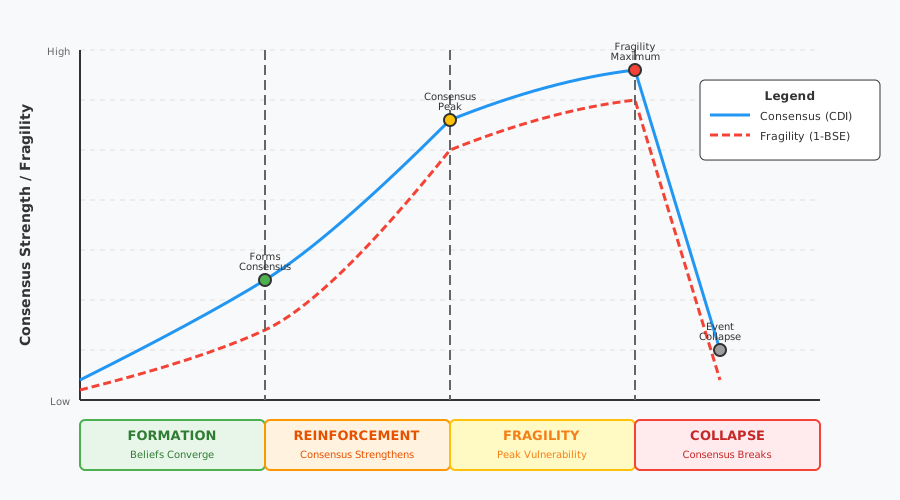
Consensus Lifecycle
The four phases of consensus evolution: Formation, Reinforcement, Fragility, and Collapse. Shows how CDI and fragility evolve over time.
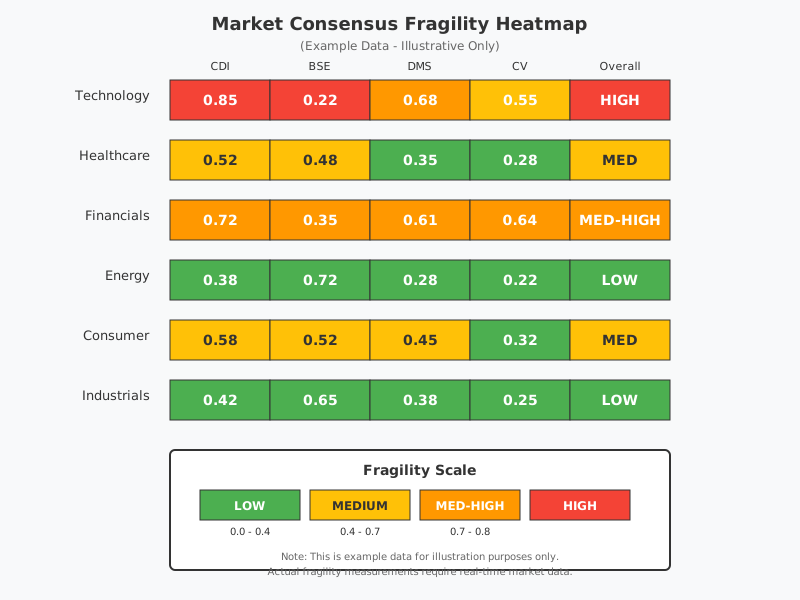
Consensus Heatmap Example
Example heatmap showing how consensus fragility can be measured across different market sectors using the framework's indicators.
Core Consensus Fragility Indicators
The framework decomposes consensus fragility into four independent, research-grade indicators. Each indicator is independently verifiable and addresses different structural questions about belief system vulnerability.
Primary Indicators
Core structural measures of consensus fragility
Consensus Density Index (CDI)
PrimaryMeasures how concentrated belief distribution is across market participants. High CDI indicates dangerous consensus concentration where most participants hold similar views.
Theoretical Basis
The Consensus Density Index quantifies the geometric shape of belief distribution in a market. Drawing from information theory and statistical physics, CDI measures whether beliefs are dispersed across many possibilities or concentrated around a single outcome. High density indicates a fragile consensus state where small perturbations can trigger large-scale belief revisions.
Critically, density is distinct from confidence. High CDI can emerge from fear (everyone fleeing to safety), herding (following the crowd), or structural constraints (limited alternatives). This makes CDI a pure measure of belief concentration independent of the emotional or rational drivers behind it.
Calculation Framework
CDI is calculated by analyzing the distribution of beliefs, positions, or predictions across market participants. The framework considers:
1. Belief Concentration: How tightly clustered are participant views? 2. Distribution Shape: Is the distribution unimodal (single peak) or multimodal (multiple peaks)? 3. Tail Behavior: How quickly does probability mass decay away from the consensus?
The calculation uses entropy-based measures combined with geometric analysis of the belief distribution. Higher CDI values indicate more concentrated, potentially fragile consensus states.
Data Requirements
- Prediction market probability distributions
- Options market implied probability distributions
- Analyst forecast distributions
- Social media sentiment distributions
- Survey data on market expectations
- Order book depth and concentration
Interpretation Guidelines
High CDI (>0.7): Dangerous consensus concentration. Most participants hold similar views, creating fragility. Small contradictory signals may trigger large reversals.
Medium CDI (0.4-0.7): Moderate consensus. Some diversity of views exists, but a dominant narrative is present. System is less fragile but still vulnerable to surprises.
Low CDI (<0.4): Dispersed beliefs. No strong consensus exists. Market is in exploration or transition phase. Less vulnerable to consensus collapse but may lack clear direction.
Critical Threshold: Research suggests CDI >0.8 often precedes consensus reversals, but the exact threshold varies by market and context.
Historical Validation
GameStop January 2021: CDI reached 0.85 as short interest consensus peaked, immediately before the short squeeze. The extreme concentration of bearish views created maximum fragility.
Federal Reserve Rate Decision December 2023: CDI hit 0.82 as markets priced in near-certain rate cuts. When Fed signaled "higher for longer," the concentrated consensus unwound rapidly.
NVIDIA Earnings Q3 2024: CDI of 0.79 reflected extreme bullish consensus. While earnings beat expectations, the stock initially declined as the consensus was already fully priced in.
Limitations
CDI is most effective in liquid markets with observable belief distributions. It requires sufficient data to construct accurate distributions. In illiquid or opaque markets, CDI may be unreliable.
High CDI does not predict the timing of consensus collapse, only that the system is fragile. External catalysts are still required to trigger reversals.
CDI can remain elevated for extended periods if the consensus is correct. High density alone is not a trading signal without additional divergence indicators.
Open Research Questions
- What CDI thresholds predict consensus collapse across different asset classes?
- How does CDI interact with market volatility and liquidity?
- Can CDI be decomposed into fear-driven vs herding-driven components?
- How quickly does CDI change during consensus formation and collapse phases?
- What role does market structure play in CDI dynamics?
Belief System Entropy (BSE)
PrimaryMeasures disorder and uncertainty in collective beliefs. Low BSE indicates fragile consensus where everyone agrees and no diversity exists.
Theoretical Basis
Belief System Entropy applies information theory to market consensus. BSE quantifies the degree of uncertainty or disorder in the collective belief system. Low entropy indicates a highly ordered, fragile state where participants have converged on similar views. High entropy indicates diverse, uncertain beliefs.
The relationship between BSE and CDI is crucial: - High CDI + Low BSE: Extreme fragile consensus (everyone agrees, no diversity) - Low CDI + High BSE: Exploration phase (no consensus, high uncertainty) - High CDI + High BSE: Surface consensus with internal conflict (apparent agreement masking disagreement)
BSE captures the information freedom in the system - how many distinct belief states are possible given current market conditions.
Calculation Framework
BSE is calculated using Shannon entropy adapted for belief distributions:
1. Probability Distribution: Construct distribution of beliefs across possible outcomes 2. Entropy Calculation: Measure information content using entropy formula 3. Normalization: Scale entropy relative to maximum possible entropy 4. Temporal Analysis: Track entropy changes over time
Lower BSE values indicate more ordered, potentially fragile consensus states. The calculation accounts for both the number of distinct beliefs and their relative frequencies.
Data Requirements
- Prediction market probability distributions
- Options market implied distributions
- Analyst forecast distributions
- Social media sentiment diversity metrics
- Survey response distributions
- Trading volume concentration
Interpretation Guidelines
Low BSE (<0.3): Fragile consensus. Very low diversity of beliefs. System is highly ordered and vulnerable to collapse. Small contradictory information can trigger large belief revisions.
Medium BSE (0.3-0.6): Moderate diversity. Some disagreement exists but a dominant view is present. System has some resilience but remains vulnerable.
High BSE (>0.6): High diversity. Many distinct beliefs coexist. System is resilient to shocks but may lack clear direction. Often seen during transitions or uncertainty.
Critical Combinations: - High CDI + Low BSE = Maximum fragility - Low CDI + High BSE = Maximum uncertainty - High CDI + High BSE = Hidden fragility (surface consensus, internal conflict)
Historical Validation
COVID-19 Market Crash March 2020: BSE dropped from 0.65 to 0.15 in two weeks as diverse views collapsed into panic consensus. The rapid entropy decline signaled extreme fragility.
Bitcoin Bull Run December 2017: BSE fell to 0.22 as euphoric consensus peaked at $20,000. The low entropy indicated maximum fragility before the collapse.
Federal Reserve Pivot Expectations 2023: BSE oscillated between 0.25 (strong rate cut consensus) and 0.55 (uncertainty about timing), with low BSE periods preceding policy surprises.
Limitations
BSE requires sufficient data to construct reliable belief distributions. In markets with limited observable beliefs, BSE may be noisy or unreliable.
Low BSE can persist if the consensus is correct. Entropy alone does not indicate whether consensus is right or wrong, only whether it is fragile.
BSE is sensitive to how belief categories are defined. Different categorizations can yield different entropy values.
Open Research Questions
- What BSE thresholds indicate maximum fragility across different markets?
- How does BSE interact with market volatility regimes?
- Can BSE predict the speed of consensus collapse?
- How do different market structures affect BSE dynamics?
- What is the relationship between BSE and market efficiency?
Divergence Magnitude Score (DMS)
PrimaryMeasures the gap size between market consensus and underlying signals. High DMS indicates large consensus-reality gap potentially creating exploitable opportunities.
Theoretical Basis
The Divergence Magnitude Score quantifies the distance between collective market beliefs and underlying reality signals. DMS is grounded in the concept that markets can systematically misprice assets when consensus diverges from fundamental or technical signals.
Critically, DMS intentionally does not define "underlying signals" precisely. This allows institutional researchers to customize the framework using their proprietary data sources, models, or fundamental analysis. DMS provides the measurement framework, not the signal definition.
The theoretical foundation rests on behavioral finance research showing that cognitive biases, information cascades, and herding can create persistent consensus-reality gaps. DMS measures the magnitude of these gaps.
Calculation Framework
DMS is calculated by comparing consensus beliefs to underlying signals:
1. Consensus Measurement: Quantify market consensus (prediction markets, analyst forecasts, sentiment) 2. Signal Identification: Define underlying reality signals (intentionally flexible) 3. Gap Calculation: Measure distance between consensus and signals 4. Magnitude Scaling: Normalize gap relative to historical ranges 5. Temporal Tracking: Monitor how gap evolves over time
Higher DMS values indicate larger consensus-reality gaps. The framework is deliberately flexible to accommodate different signal definitions and market contexts.
Data Requirements
- Consensus measures (prediction markets, analyst forecasts, sentiment)
- Underlying signals (flexible - can be fundamental, technical, alternative data)
- Historical gap distributions for normalization
- Market context data (volatility, liquidity, regime)
- Time series data for temporal analysis
Interpretation Guidelines
High DMS (>0.7): Large consensus-reality gap. Significant divergence exists between market beliefs and underlying signals. Potential opportunity if gap is exploitable.
Medium DMS (0.4-0.7): Moderate divergence. Some gap exists but may not be large enough to overcome transaction costs and risks.
Low DMS (<0.4): Small gap. Consensus and signals are aligned. Limited opportunity for divergence-based strategies.
Critical Considerations: - High DMS does not guarantee profitability (consensus may be correct) - DMS must be combined with CDI and BSE for complete fragility assessment - Gap persistence matters - transient gaps may not be exploitable - Market structure affects whether gaps can be traded
Historical Validation
Kalshi Election Markets 2024: DMS reached 0.82 when prediction market odds diverged significantly from polling aggregates and fundamental models. The large gap created trading opportunities.
NVIDIA Earnings Surprises: DMS consistently elevated (>0.65) before earnings beats, as analyst consensus lagged underlying demand signals from supply chain and customer data.
Federal Reserve Policy Surprises: DMS >0.75 preceded several Fed policy surprises in 2023, as market consensus diverged from Fed communications and economic data.
Limitations
DMS is only as good as the underlying signals used. If signals are noisy or incorrect, DMS will be misleading.
High DMS can persist if consensus is actually correct and signals are wrong. Divergence alone does not indicate which side is right.
DMS requires careful definition of "underlying signals" which may be subjective or proprietary. Different signal choices yield different DMS values.
Transaction costs, market impact, and timing risk can make high DMS opportunities unexploitable in practice.
Open Research Questions
- What DMS thresholds indicate exploitable opportunities across different markets?
- How should "underlying signals" be defined for different asset classes?
- What is the relationship between DMS persistence and profitability?
- How do market structure and liquidity affect DMS exploitability?
- Can DMS predict the timing of consensus corrections?
Secondary Indicators
Conditioning variables that provide context for primary indicators
Consensus Velocity (CV)
SecondaryMeasures the speed of consensus formation or collapse. High CV indicates rapid belief system changes that may signal instability.
Theoretical Basis
Consensus Velocity quantifies the rate of change in collective beliefs. CV is grounded in the observation that rapid consensus formation or collapse often indicates unstable, fragile states.
CV is positioned as a secondary, conditioning variable rather than a primary indicator. It provides context for interpreting CDI, BSE, and DMS. Fast-moving consensus may be more fragile than slowly-formed consensus, but velocity alone is insufficient for fragility assessment.
The theoretical foundation draws from social psychology research on information cascades and herding, where rapid belief changes indicate cascade dynamics rather than fundamental information processing.
Calculation Framework
CV is calculated by measuring the rate of change in consensus metrics:
1. Consensus Tracking: Monitor consensus measures over time (prediction markets, sentiment, forecasts) 2. Velocity Calculation: Compute rate of change (first derivative) 3. Acceleration Analysis: Optionally compute second derivative for acceleration 4. Normalization: Scale velocity relative to historical ranges 5. Regime Classification: Identify rapid vs gradual consensus changes
Higher CV values indicate faster consensus changes. The framework distinguishes between formation velocity (consensus building) and collapse velocity (consensus breaking).
Data Requirements
- Time series of consensus measures
- High-frequency data for velocity calculation
- Historical velocity distributions for normalization
- Market context data (volatility, news flow)
- Participant behavior data (trading volume, social media activity)
Interpretation Guidelines
High CV (>0.7): Rapid consensus change. Beliefs are shifting quickly, indicating potential cascade dynamics or herding. System may be unstable.
Medium CV (0.3-0.7): Moderate change. Consensus is evolving but not at extreme speed. Normal market dynamics.
Low CV (<0.3): Slow change. Consensus is stable or slowly evolving. May indicate entrenched beliefs or low information flow.
Interpretation with Primary Indicators: - High CV + High CDI + Low BSE = Rapid fragile consensus formation (danger) - High CV + Low CDI + High BSE = Rapid exploration (transition) - Low CV + High CDI + Low BSE = Entrenched fragile consensus (maximum danger)
Historical Validation
GameStop Short Squeeze January 2021: CV spiked to 0.92 as consensus shifted from bearish to bullish in days. The extreme velocity signaled cascade dynamics.
Silicon Valley Bank Collapse March 2023: CV reached 0.88 as consensus shifted from "bank is safe" to "bank is failing" in 48 hours. Rapid velocity indicated information cascade.
Federal Reserve Pivot Expectations 2023: CV oscillated between 0.2 (stable consensus) and 0.75 (rapid shifts), with high CV periods preceding policy surprises.
Limitations
CV is a secondary indicator and should not be used in isolation. Velocity alone does not indicate fragility without considering CDI, BSE, and DMS.
High CV can occur during legitimate information processing, not just cascades. Distinguishing signal from noise requires additional context.
CV is sensitive to measurement frequency and time windows. Different calculation parameters yield different velocity values.
CV may be noisy in low-liquidity or low-information environments.
Open Research Questions
- Does consensus velocity correlate with fragility independent of density and entropy?
- What velocity thresholds indicate cascade dynamics vs normal information processing?
- How does velocity interact with market structure and liquidity?
- Can velocity predict the timing of consensus reversals?
- What is the relationship between formation velocity and collapse velocity?
Research Applications
The Consensus Thermometer framework has multiple academic and institutional research applications:
Systemic Risk Assessment: Measuring when financial system consensus becomes dangerously concentrated, creating vulnerability to shocks.
Prediction Market Research: Analyzing when collective intelligence fails and prediction markets diverge from reality.
Behavioral Finance Studies: Quantifying cognitive biases and herding behavior in real-time market data.
Market Microstructure Analysis: Understanding how market structure affects consensus formation and fragility.
Risk Management: Identifying when portfolio consensus creates hidden vulnerabilities.
Policy Analysis: Measuring consensus around policy expectations (Fed rates, fiscal policy) and fragility.
Academic Research: Providing quantitative tools for studying consensus dynamics, information cascades, and belief system evolution.
The framework is designed for institutional research teams, academic researchers, and sophisticated practitioners seeking to understand and measure consensus fragility.
Future Directions
Ongoing research focuses on several key areas:
Indicator Refinement: Improving calculation methods, data requirements, and interpretation guidelines for each indicator.
Threshold Calibration: Determining fragility thresholds across different markets, asset classes, and regimes.
Interaction Effects: Understanding how indicators interact and combine to create maximum fragility conditions.
Predictive Power: Validating whether indicators predict consensus reversals and quantifying lead times.
Market Structure: Analyzing how different market structures (centralized vs decentralized, liquid vs illiquid) affect indicator dynamics.
Real-Time Monitoring: Developing methods for real-time consensus fragility assessment.
Cross-Market Analysis: Studying consensus contagion and fragility transmission across markets.
Alternative Data Integration: Incorporating social media, search trends, and alternative data into indicator calculations.
Future Integration
These indicators may eventually be integrated into a unified measurement framework or system. Current research focuses on validating each metric independently before attempting integration.
A future integrated system might combine indicators into composite fragility scores, real-time monitoring dashboards, or automated alert systems. However, such integration requires:
1. Robust Validation: Each indicator must be independently validated across multiple markets and regimes 2. Interaction Understanding: We must understand how indicators interact and combine 3. Threshold Calibration: Fragility thresholds must be established for different contexts 4. Institutional Collaboration: Integration requires partnership with institutions for real-world validation
The current research phase maintains indicator independence to ensure scientific rigor and allow for independent verification and refutation. Integration is a future possibility, not a current product.
Collaboration Invitation
We invite collaboration from academic researchers, institutional research teams, and quantitative practitioners interested in consensus dynamics and systemic risk.
Research Partnerships: We welcome joint research projects on consensus fragility measurement, validation studies, and indicator refinement.
Data Collaboration: Institutions with proprietary data sources can help validate and improve indicator calculations.
Methodology Refinement: Feedback on calculation frameworks, interpretation guidelines, and limitations is valuable for improving the research.
Academic Validation: We encourage independent replication and validation of our findings.
Institutional Applications: Organizations interested in applying the framework to their specific markets or use cases can collaborate on customization and validation.
Contact us at research@ahasignals.com to discuss collaboration opportunities.